Why More Website Traffic Doesn't Necessarily Mean More Customers
A business may see organic traffic increasing, paid campaigns sending hundreds of visitors to the website, or analytics showing that more people are discovering its pages. On the surface, those numbers look encouraging.
But there is a problem: website traffic is not the same thing as business growth.
A website can receive thousands of visits and still generate very few enquiries, calls, bookings, purchases, or qualified leads. On the other hand, a smaller website with highly relevant visitors can sometimes produce significantly better business results.
The difference is not simply the number of people visiting the website. It is who those people are, why they arrived, what they find when they land, and what happens next.
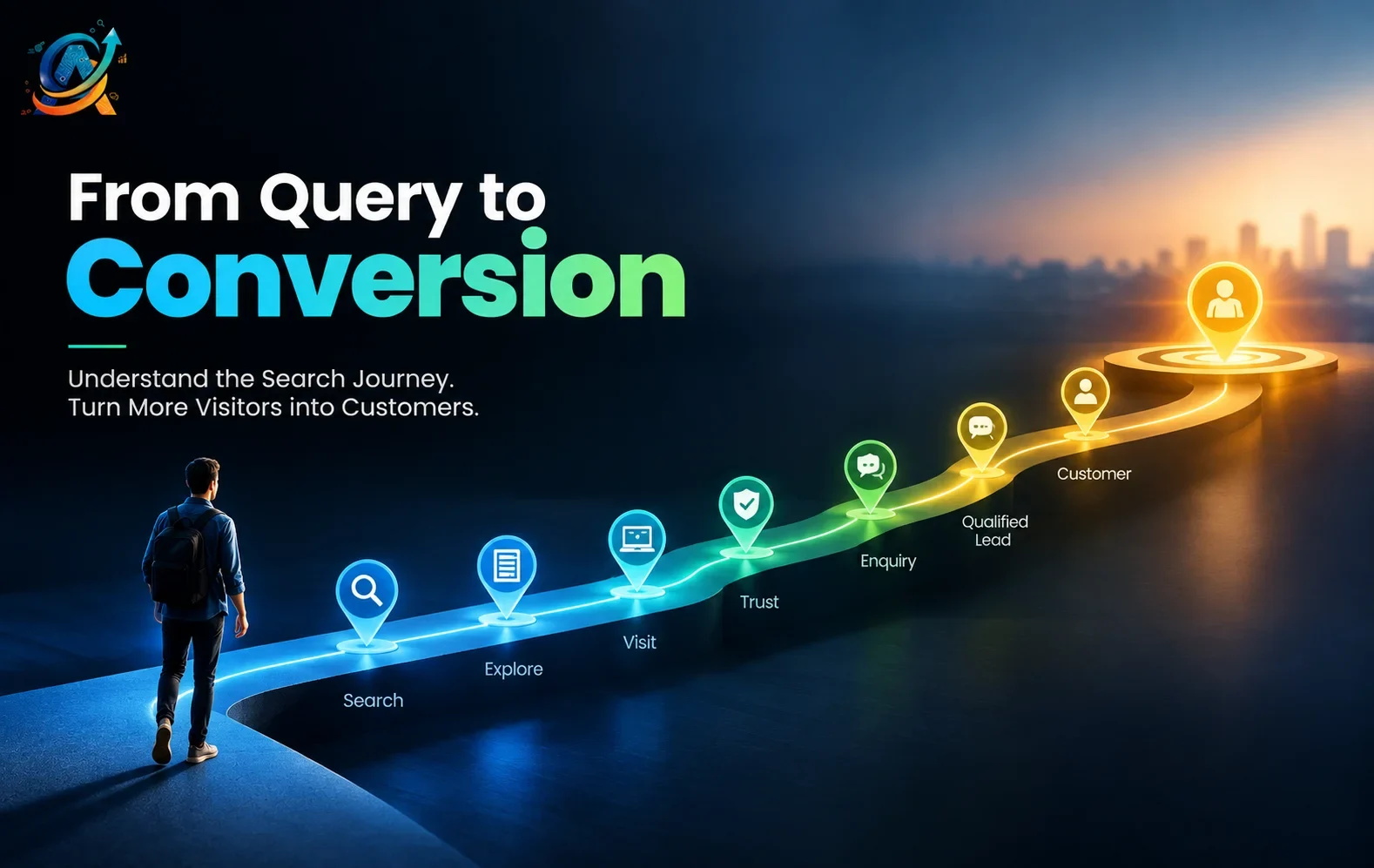
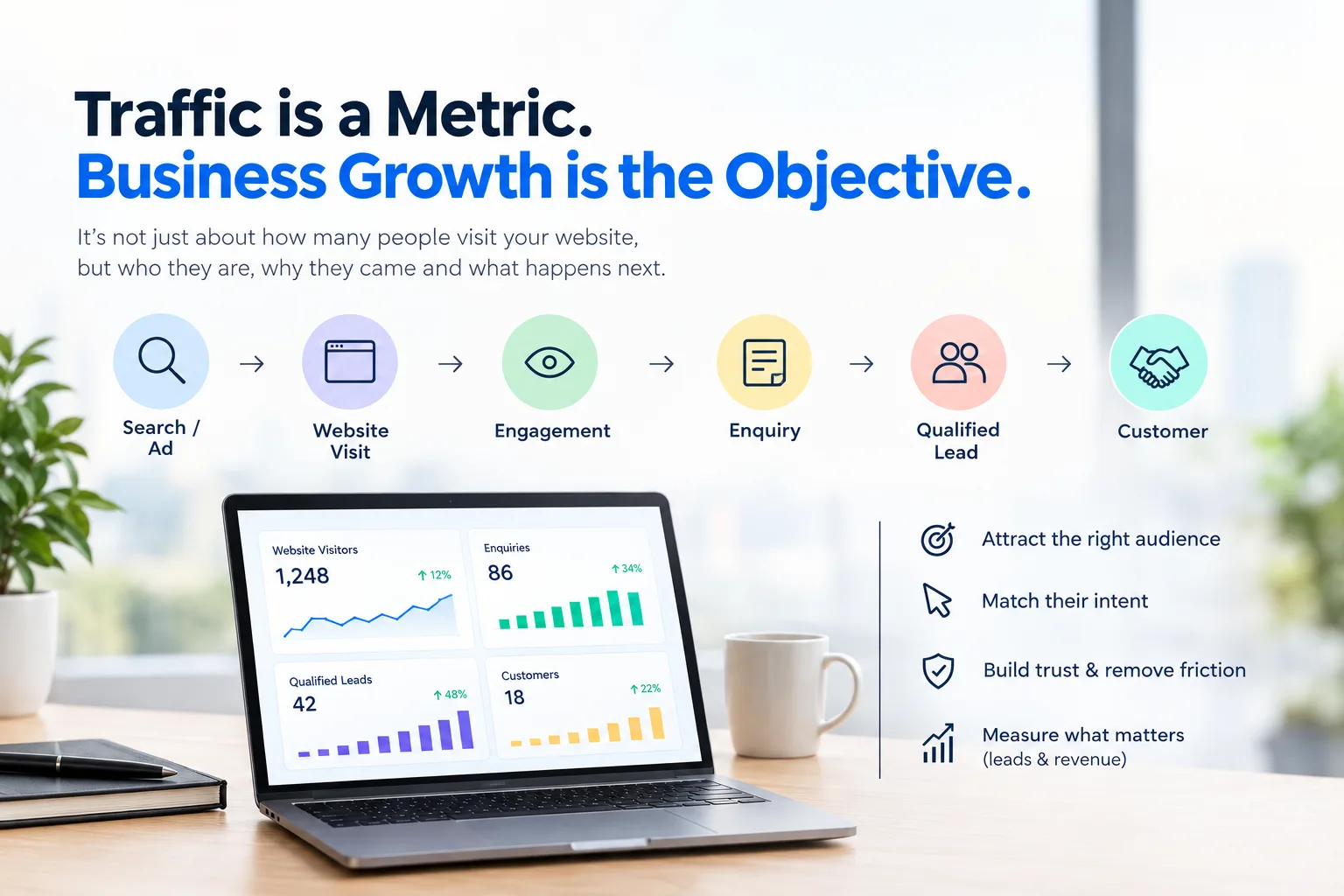
This is why businesses should look beyond traffic volume and examine the complete journey from search or advertisement → website visit → engagement → enquiry → qualified lead → customer.
Traffic Is a Starting Point, Not the Final Result
Website traffic tells you that people reached your website.
It does not automatically tell you:
- whether they were the right audience;
- whether they had genuine buying intent;
- whether they understood what the business offers;
- whether the landing page matched their expectations;
- whether they trusted the business;
- whether the website made it easy to take the next step;
- whether enquiries were actually relevant;
- or whether those enquiries eventually became customers.
Consider two businesses.
Business A receives 5,000 monthly visitors and generates 20 enquiries.
Business B receives 1,000 monthly visitors and generates 30 enquiries.
If you looked only at traffic, Business A would appear to be performing better.
But if the objective is qualified enquiries, the picture is different.
The important question therefore isn't simply:
"How much traffic are we getting?"
A better question is:
"What is the business getting from the traffic it receives?"
That shift—from traffic volume to business outcomes—is fundamental to measuring digital marketing properly.
Why High Traffic Can Still Produce Poor Results
There are several reasons why traffic may fail to translate into customers.
1. The Traffic Isn't Relevant
Not every visitor has the same value.
Someone searching for:
"what is digital marketing?"
has a very different intent from someone searching for:
"digital marketing agency for lead generation"
The first person may be researching a concept. The second may already be evaluating potential providers.
Both searches can generate website traffic, but their commercial value can be very different.
This is why keyword selection, search intent, audience targeting, geographic targeting and campaign structure matter.
A campaign that produces inexpensive traffic can still perform poorly if the visitors have little interest in the actual service.
2. The Landing Page Doesn't Match the Visitor's Intent
Imagine someone clicks an advertisement for SEO services and arrives on a page that contains only a generic description of digital marketing.
The visitor now has to figure out:
- whether SEO is actually offered;
- what type of SEO is provided;
- who the service is intended for;
- how the process works;
- whether the company has relevant experience;
- and how to make contact.
The advertisement may have done its job by generating the click.
The website, however, has not completed the next part of the journey.
A strong landing experience should answer the visitor's most important questions without forcing them to search through unrelated pages.
The closer the connection between query, advertisement, landing page and next action, the less friction the visitor has to overcome.
3. The Website Explains the Service but Not the Business Problem
Many websites describe what they sell.
For example:
"We provide SEO, Google Ads and social media marketing."
That communicates the services, but it may not answer the more important question:
"How will this help my business?"
A potential customer may actually be concerned about:
- inconsistent enquiries;
- expensive advertising;
- low-quality leads;
- declining organic visibility;
- poor conversion rates;
- difficulty measuring marketing performance;
- or uncertainty about which channel deserves more budget.
A useful website connects its services to these real business problems.
Instead of simply listing capabilities, it should explain the relationship between the problem, the strategy, the implementation and the expected measurement.
4. There Is Too Much Friction Between the Visitor and the Enquiry
Even an interested visitor can abandon a website if taking the next step is unnecessarily difficult.
Common friction points include:
- unclear calls to action;
- forms with too many fields;
- missing contact information;
- slow pages;
- difficult mobile navigation;
- confusing service structures;
- weak trust information;
- unclear pricing expectations;
- or a lack of information needed to make a decision.
The solution is not necessarily to add more buttons everywhere.
The better approach is to make the next logical action obvious.
For a service business, that could be:
- request a consultation;
- enquire about a service;
- discuss a project;
- request an audit;
- call the business;
- or submit a lead form.
The appropriate action depends on the business model and the visitor's stage in the decision process.
Traffic Quality Matters More Than Traffic Volume Alone
A useful way to evaluate website traffic is to divide the journey into several stages.
Stage 1: Visibility
People discover the business through:
- Google Search;
- advertisements;
- social media;
- referrals;
- direct visits;
- local search;
- or other channels.
Stage 2: Visit
The person actually reaches the website.
Stage 3: Engagement
The visitor finds enough relevance to continue exploring.
They may:
- read a service page;
- visit another page;
- review an example;
- check the company information;
- use a tool;
- or investigate the business further.
Stage 4: Conversion
The visitor takes a meaningful action.
Examples include:
- submitting an enquiry;
- calling;
- requesting a quotation;
- booking a consultation;
- purchasing;
- or completing another defined business goal.
Stage 5: Qualification
Not every conversion is a good lead.
A business should distinguish between:
total leads and qualified leads.
For example, 100 form submissions may look impressive until the sales team discovers that most submissions are irrelevant, outside the service area, looking for something the company doesn't provide, or simply not serious prospects.
Stage 6: Business Outcome
The final question is:
Did the marketing activity contribute to actual business?
Depending on the business, this might mean:
- qualified opportunities;
- sales;
- recurring customers;
- revenue;
- bookings;
- or another measurable business outcome.
This is why traffic should be viewed as one part of a larger system rather than the definition of success.
A Simple Example of the Difference
Suppose a website receives 10,000 visitors.
The number alone tells you very little.
Now break it down:
Now the business has a much clearer picture.
Instead of asking:
"How can we get 20,000 visitors?"
the marketing team can ask more useful questions:
- Why did only a portion of visitors engage?
- Which sources produced the qualified enquiries?
- Which landing pages generated the strongest leads?
- Which search queries produced commercial intent?
- Which campaigns produced poor-quality traffic?
- Where are potential customers leaving the funnel?
- Which conversion actions are actually connected to revenue?
Those questions lead to better optimization decisions.
SEO Traffic Has the Same Challenge
Organic search traffic is valuable, but ranking for a keyword does not automatically create customers.
A page may rank for a broad informational search and receive substantial impressions and clicks without generating many commercial enquiries.
That doesn't necessarily mean the SEO work has failed.
The page may be serving an informational intent rather than a transactional intent.
For example:
Informational:
how does SEO work?
Commercial investigation:
SEO services for small businesses
Transactional:
SEO agency near me
These searches represent different stages of the decision process.
A mature SEO strategy therefore shouldn't focus only on increasing the total number of organic visits. It should build an appropriate combination of:
- informational content;
- commercial service pages;
- strong internal linking;
- relevant search-intent targeting;
- useful landing experiences;
- and conversion paths.
Paid Traffic Has the Same Problem
The same principle applies to Google Ads, Meta Ads and other paid channels.
A campaign can produce:
- impressions;
- clicks;
- low CPC;
- high CTR;
- and even many leads.
Yet the business may still struggle to generate meaningful results.
Why?
Because a low-cost click is not necessarily a valuable click.
For example, suppose Campaign A produces leads at ₹200 each while Campaign B produces leads at ₹500 each.
At first glance, Campaign A looks cheaper.
But imagine:
- Campaign A produces 100 leads;
- only 5 are qualified;
- Campaign B produces 40 leads;
- 15 are qualified.
The cheaper lead may not actually be the better business outcome.
This is why campaign evaluation needs to move beyond surface-level metrics.
The Website Is Part of the Marketing System
One common mistake is treating the website as a separate asset from advertising and SEO.
In reality, the website sits in the middle of many marketing journeys.
A simplified system looks like this:
Search query
↓
Search result or advertisement
↓
Website landing page
↓
Relevant information
↓
Trust and consideration
↓
Call to action
↓
Lead
↓
Qualification
↓
Customer
If one part of this system is weak, increasing traffic may simply increase the number of people reaching the same bottleneck.
For example:
More traffic + poor conversion experience = more visitors leaving without enquiring.
Likewise:
More leads + poor lead qualification = more work without proportional business value.
The objective should therefore be to improve the system, not simply maximize one number.
What Businesses Should Measure Instead of Traffic Alone
Traffic still matters. It is simply not enough on its own.
A practical measurement framework can include:
Acquisition
- impressions;
- clicks;
- sessions;
- traffic source;
- search queries;
- campaign source;
- geographic performance.
Engagement
- landing-page engagement;
- relevant page views;
- interaction with important elements;
- return visits where appropriate.
Conversion
- enquiry submissions;
- calls;
- consultation requests;
- purchases;
- bookings;
- other defined conversion actions.
Lead Quality
- relevant enquiries;
- qualified leads;
- sales opportunities;
- invalid or irrelevant leads;
- lead-to-opportunity rate.
Business Outcomes
- customers acquired;
- revenue;
- customer acquisition cost;
- return on marketing investment;
- repeat business where relevant.
The exact metrics should depend on the business model. A lead-generation agency, ecommerce company and local service provider should not necessarily use identical measurement frameworks.
How to Turn More Traffic Into More Valuable Outcomes
There is no single conversion trick that works for every website.
Instead, businesses should investigate the complete journey.
Start with the traffic source
Ask:
Where are visitors coming from?
Then examine whether those sources match the intended audience.
Examine search or campaign intent
Ask:
Why did this person click?
A visitor arriving through a highly specific commercial search may need a different landing experience from someone arriving through an educational article.
Review the landing page
Ask:
Does the page immediately satisfy the expectation created before the click?
If the answer is no, the problem may be relevance rather than traffic.
Examine the conversion path
Ask:
What does the visitor need to do next?
The action should be clear and appropriate to the user's stage.
Measure what happens after the conversion
Ask:
Are these actually good leads?
This is where marketing measurement becomes much more useful than simply counting form submissions.
The Bigger Lesson: Don't Optimize for a Number Without Understanding What It Represents
Traffic is easy to display in a report.
That makes it tempting to use it as the headline measure of marketing success.
But numbers need context.
A rise in traffic can be positive if it comes from relevant audiences and contributes to meaningful conversions.
A rise in traffic can also be less useful if it comes from audiences that have little commercial relevance.
The same principle applies to almost every digital marketing metric.
More clicks aren't automatically better.
More impressions aren't automatically better.
More leads aren't automatically better.
The important question is whether the additional activity contributes to the outcome the business actually wants.
A Better Digital Marketing Mindset
A stronger approach starts with the business objective and works backward.
Instead of:
"How can we get more traffic?"
ask:
"What kind of customer are we trying to attract?"
Then:
"What would that customer search for?"
Then:
"What information would they need before contacting us?"
Then:
"Which page should answer that need?"
Then:
"What should the visitor do next?"
And finally:
"How will we determine whether that visitor became a meaningful business opportunity?"
This approach creates a connection between search visibility, website experience, lead generation and business measurement.
For businesses looking to build their marketing around measurable outcomes rather than traffic alone, a data-backed digital marketing approach can connect acquisition, website performance, conversion tracking and campaign analysis into one broader system.
Final Takeaway
More website traffic can be useful, but traffic should not become the destination.
The real opportunity is to attract relevant people, give them information that matches their intent, remove unnecessary friction, make the next step clear, and measure what happens after they convert.
A website with 10,000 visitors is not automatically more successful than one with 1,000.
The more useful question is:
How effectively does the website turn relevant attention into meaningful business outcomes?
When SEO, paid advertising, website experience, conversion tracking and lead qualification are considered together, businesses can make much better decisions about where to invest their marketing resources.
Traffic is a metric.
Business growth is the objective.