The Search Journey Before a Customer Contacts a Business: From Query to Conversion
A person may search for a problem they are trying to solve, compare different options, investigate prices, look at reviews, visit several websites, return to a search engine later, interact with an advertisement, or check a business on another platform before finally deciding to make contact.
That entire process is the customer search journey.
For businesses investing in SEO, Google Ads, Meta Ads, websites, content, and other digital marketing activities, understanding this journey is important because the first click is not necessarily the moment when a customer makes a decision.
A visitor who discovers a business today may become a lead several days later.
Another person may search for the same service, click an advertisement, leave the website, return through an organic result, and finally submit an enquiry after comparing several providers.
This means digital marketing should not be viewed simply as a process of generating website visits.
It is better understood as a sequence:
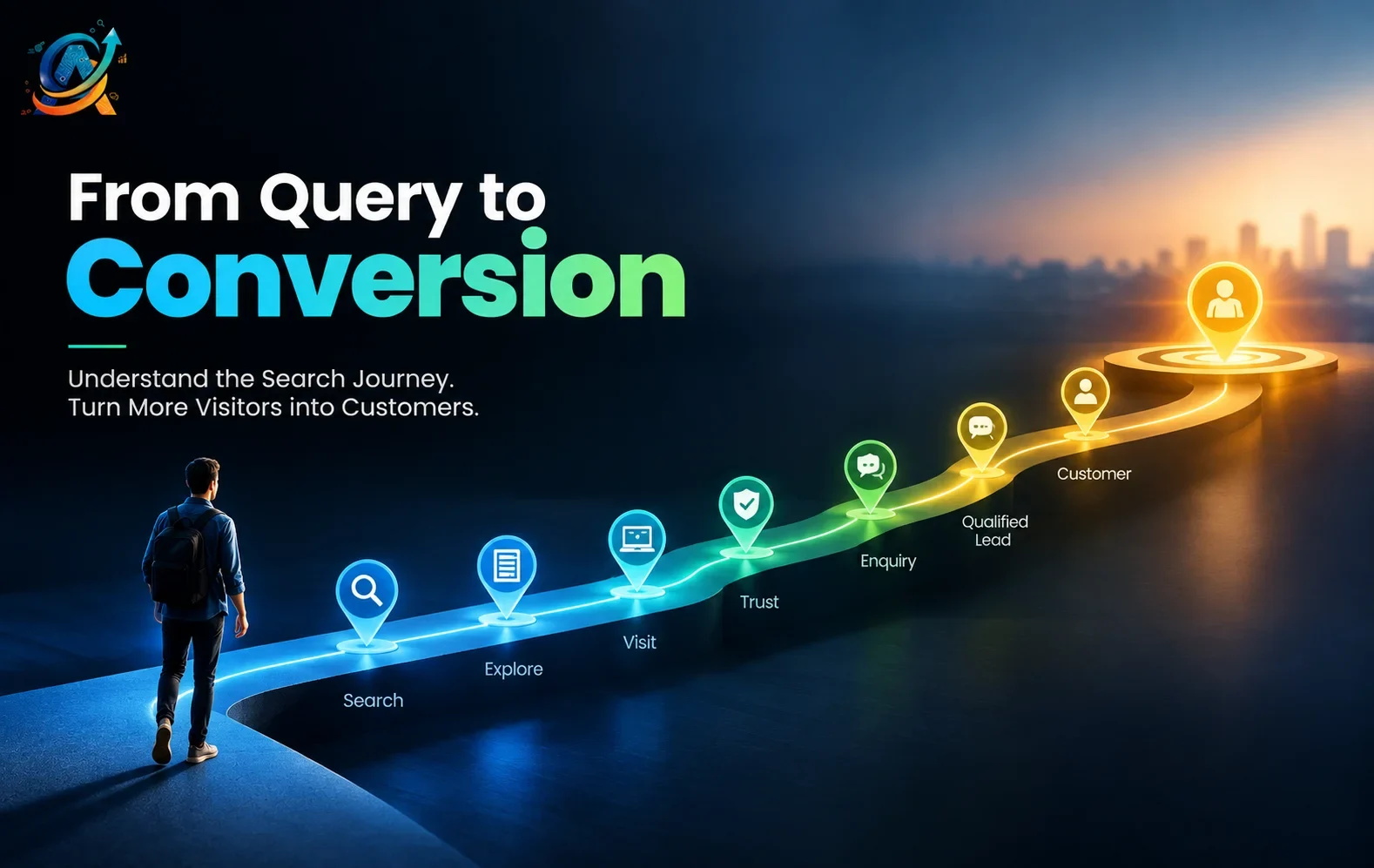
Search → Discovery → Evaluation → Website Interaction → Trust → Enquiry → Qualification → Conversion
Understanding what happens at each stage can help businesses identify where potential customers are being lost and where their marketing system needs improvement.
What Is a Customer Search Journey?
A customer search journey describes the sequence of actions a person takes while researching a product, service, business, or solution before taking a meaningful commercial action.
The journey can include:
- Searching on Google
- Reading search results
- Clicking an advertisement
- Visiting a website
- Reading educational content
- Comparing businesses
- Checking service pages
- Looking for pricing information
- Reading reviews
- Returning to the website
- Calling the business
- Sending a WhatsApp message
- Filling out a contact form
- Requesting a quotation
- Speaking with a salesperson
- Becoming a customer
Importantly, not every customer follows the same sequence.
Someone who already knows what they want may move from a high-intent search directly to an enquiry.
Someone unfamiliar with a service may spend considerably more time researching before contacting a business.
Therefore, businesses should not assume that every visitor has the same level of buying intent.
The Journey Often Starts Before the Business Is Even Discovered
One of the biggest misunderstandings in digital marketing is assuming that the customer journey begins when someone lands on a company's website.
In reality, it can begin much earlier.
Imagine a business owner wants to improve the number of enquiries coming from its website.
The owner might initially search:
"Why is my website not generating leads?"
Later, the same person may search:
"How to improve website conversion rate"
After learning more, they might search:
"digital marketing agency for lead generation"
Eventually, they may begin comparing specific agencies.
At each stage, the person's intent changes.
The first search is primarily about understanding a problem.
The later search has much stronger commercial intent.
This is why a business can benefit from understanding the difference between search intent and simply counting keywords or visitors.
Stage 1: Problem Awareness
The first stage often begins with a problem rather than a specific company or service.
A potential customer may not know exactly what solution they need.
For example:
- "Why are my website visitors not converting?"
- "How can I get more enquiries online?"
- "Why are my Google Ads expensive?"
- "How can my local business appear on Google?"
- "Why is my website traffic increasing but sales not increasing?"
These searches indicate that the person is trying to understand a problem.
At this point, aggressively pushing a sales message may not be the most useful approach.
The visitor may first need an explanation.
This is where high-quality informational content can become valuable.
A useful article can explain the problem, identify possible causes, provide practical considerations, and help the reader understand what should happen next.
The objective is not necessarily to generate an immediate enquiry from every informational visitor.
Instead, the content can help establish relevance and create a path toward further research.
Stage 2: Solution Research
Once the potential customer understands the problem, the next question is often:
"What can solve this?"
The search behaviour may become more specific.
For example:
- "SEO for local business"
- "Google Ads for service businesses"
- "lead generation strategy"
- "digital marketing services"
- "how to improve website leads"
The person is now moving from problem awareness toward solution awareness.
This stage is important because the customer is beginning to connect their problem with possible solutions.
A business's content should therefore answer practical questions rather than simply repeat promotional statements.
Useful content might explain:
- How a particular solution works
- When it makes sense
- What factors affect results
- What businesses should prepare beforehand
- Which metrics matter
- Common mistakes
- What implementation normally involves
The stronger the information, the easier it becomes for the visitor to evaluate whether the solution is relevant to them.
Stage 3: Provider Discovery
After understanding the type of solution required, the potential customer may start looking for businesses that provide it.
This is where searches become more commercially specific.
Examples might include:
- "digital marketing agency in Meerut"
- "SEO company in Noida"
- "Google Ads agency in Delhi NCR"
- "Meta Ads agency near me"
At this stage, the customer is no longer simply researching a problem.
They are identifying potential providers.
However, appearing in search results does not automatically mean the customer will choose the business.
The search result is only the beginning of the evaluation process.
The person may open several websites and compare:
- Services
- Experience
- Areas served
- Case studies
- Reviews
- Communication options
- Website quality
- Contact information
- Business credibility
- Pricing information where available
- Whether the company appears suitable for their specific situation
This is why search visibility and conversion experience need to work together.
Stage 4: Website Evaluation
A website often becomes one of the most important evaluation points in the customer's journey.
The visitor is effectively asking:
"Is this business relevant enough for me to consider?"
A strong website should make that question easier to answer.
The visitor should be able to understand:
- What the business does
- Who it serves
- Which services are available
- What problems those services address
- Where the business operates
- Why the business may be relevant
- How to contact the business
- What evidence supports its claims
This does not mean every website needs hundreds of sections or complicated design.
Clarity can be more useful than complexity.
A visitor should not have to search through multiple pages simply to understand what the company actually offers.
Stage 5: Trust and Comparison
Even when someone is interested in a service, they may not contact the first business they discover.
Comparison is normal.
A customer might open three, five, or even more websites before deciding which businesses deserve further consideration.
During this stage, trust becomes increasingly important.
The customer may look for evidence such as:
- Genuine case studies
- Clearly explained services
- Real business information
- Relevant experience
- Customer reviews
- Industry knowledge
- Transparent communication
- Useful educational content
- Consistent information across online profiles
This is one reason businesses should be careful with exaggerated claims.
Statements such as "guaranteed results" or unsupported superlatives may attract attention, but they can also create questions about credibility.
Specific evidence is usually more useful.
For example, instead of simply saying that a company is "the best," a business can explain what it actually does, how its process works, what it measures, and what type of businesses it works with.
Stage 6: The First Conversion
The customer journey eventually reaches a point where the visitor takes an action.
That action could be:
- Calling the business
- Filling out a form
- Sending a WhatsApp message
- Requesting a quotation
- Booking a consultation
- Asking for more information
- Visiting the business
- Purchasing directly
This is often where businesses define a "conversion."
But there is an important distinction.
A conversion is not always the same as a customer.
Someone can submit a form without being a suitable prospect.
Someone can call and ask a question without intending to purchase.
Someone can request a quotation and never respond again.
Therefore, measuring only the number of conversions can hide an important part of the customer journey.
From Conversion to Qualified Lead
Consider two businesses.
Business A receives 100 enquiries but only five are relevant.
Business B receives 40 enquiries and 20 are relevant.
Looking only at enquiry volume, Business A appears to be generating more activity.
Looking at qualified opportunities, the situation is different.
This is why businesses should distinguish between:
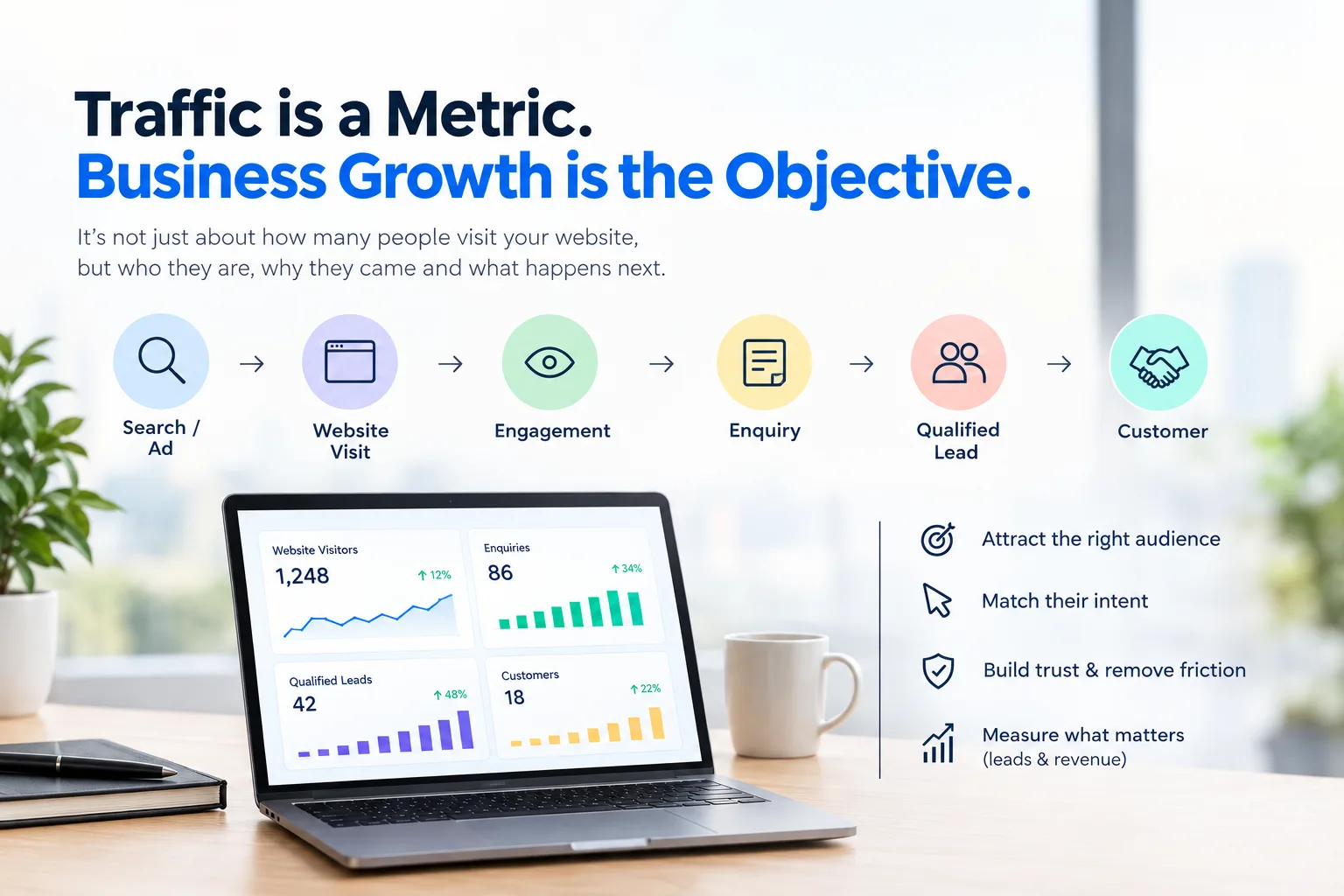
Visitors → Leads → Qualified Leads → Opportunities → Customers
Each stage tells a different story.
For example:
The exact numbers will differ from business to business.
The important point is that every stage represents a different part of the commercial journey.
A business that measures only the first stage may miss problems occurring later.
Why Different Marketing Channels Can Influence the Same Customer
Another reason the customer journey is difficult to understand is that people do not necessarily use one marketing channel from beginning to end.
A potential customer might:
- Discover an educational article through Google.
- Visit the website.
- Leave without contacting the business.
- Later see a Meta advertisement.
- Search the business name on Google.
- Visit the service page.
- Read a case study.
- Call the business.
Which channel generated the customer?
The answer may depend on how the business defines and measures attribution.
The first interaction and the final interaction are not necessarily the only meaningful interactions.
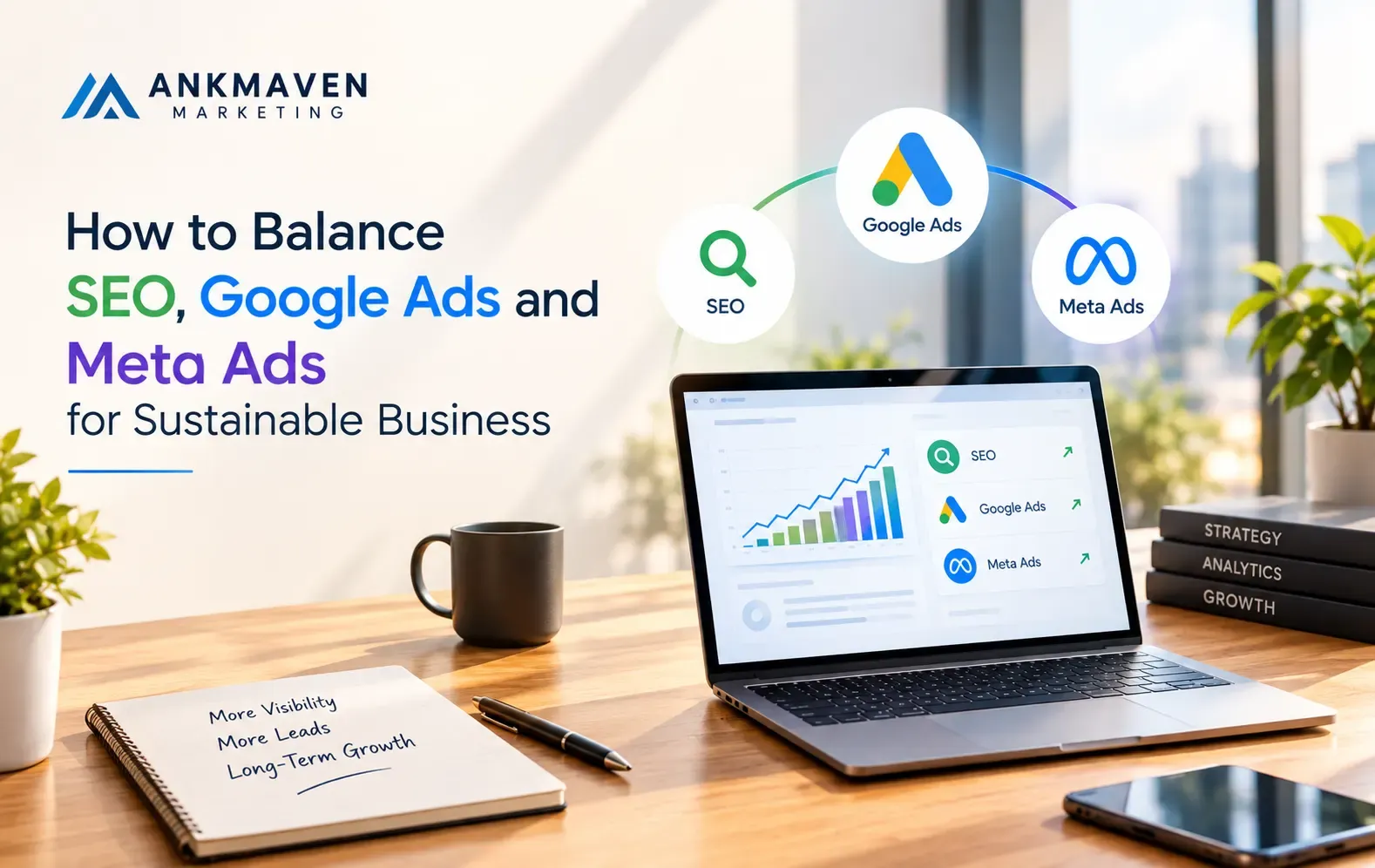
This is why SEO, Google Ads, Meta Ads, website content, conversion tracking, and follow-up systems should not always be treated as completely isolated activities.
A more connected full-funnel digital marketing approach can help businesses understand how different activities contribute at different points in the customer's journey.
The Search Journey Is Not Always Linear
A traditional marketing funnel is often shown as a straight path:
Awareness → Consideration → Conversion
Real customer behaviour can be much less predictable.
A person may move backward and forward between stages.
For example:
Search → Article → Website → Leave → Search Again → Advertisement → Website → Review → Search Again → Contact
Another customer may take a much shorter route:
Commercial Search → Service Page → Phone Call
Both journeys can result in a customer.
The difference is the customer's existing knowledge, urgency, trust level, budget, and intent.
Therefore, businesses should avoid designing their entire marketing system around the assumption that every visitor follows exactly the same path.
What Businesses Should Measure Across the Search Journey
A useful measurement system should go beyond website traffic.
Depending on the business model, useful metrics may include:
Discovery metrics
- Search impressions
- Organic clicks
- Paid ad impressions
- Click-through rate
- Branded search activity
Website engagement metrics
- Landing page engagement
- Important page views
- Scroll or interaction behaviour where meaningful
- Returning visitors
- Form interactions
Conversion metrics
- Form submissions
- Phone calls
- WhatsApp enquiries
- Consultation requests
- Purchases
Lead-quality metrics
- Qualified enquiries
- Sales opportunities
- Cost per qualified lead
- Lead-to-opportunity rate
Business outcome metrics
- Customers acquired
- Revenue generated
- Customer acquisition cost
- Return on advertising spend where applicable
- Customer lifetime value where measurable
Not every business needs every metric.
The important principle is to connect measurement with actual business objectives.
What Happens When One Stage of the Journey Is Weak?
A marketing system can generate activity while still producing poor results if one important stage is broken.
For example:
Strong traffic + weak landing page
Many people arrive, but few understand what to do next.
Strong website + irrelevant traffic
The website works well, but visitors are not the right audience.
Strong leads + poor qualification
The business receives many enquiries but spends time on prospects who are unlikely to become customers.
Strong advertising + weak follow-up
The campaign generates enquiries, but slow or inconsistent follow-up causes opportunities to disappear.
Strong SEO + weak commercial pages
People discover the website through informational content but cannot easily find the relevant service or next step.
These examples show why improving one marketing metric in isolation may not solve the underlying business problem.
How Businesses Can Improve the Search-to-Conversion Journey
A practical approach starts by mapping the journey.
Ask:
1. What problem does the customer search for first?
Identify the questions people ask before they know which solution they need.
2. What information helps them evaluate solutions?
Create useful content that answers genuine questions rather than filling pages with keywords.
3. What searches indicate stronger commercial intent?
Identify searches that suggest the person is actively evaluating providers.
4. What happens when they reach the website?
Check whether the landing page actually matches the search or advertisement.
5. What evidence helps them trust the business?
Use genuine information, case studies, reviews, experience, and clear business details.
6. What is the intended next step?
Make the appropriate action easy to understand.
7. What happens after the enquiry?
Track whether leads are contacted, qualified, followed up, and eventually converted.
This creates a much clearer picture than simply asking whether website traffic increased.
Content Should Support Different Stages of Intent
A strong content strategy does not need every article to sell a service.
Different pieces of content can answer different customer questions.
For example:
Informational content
Helps people understand a problem.
Educational content
Helps people understand possible solutions.
Comparison content
Helps people evaluate alternatives.
Service pages
Explain what the business actually provides.
Case studies
Provide evidence of relevant work.
Contact or enquiry pages
Provide a clear path to action.
This creates a connected content ecosystem.
The goal is not to make every page rank for the same commercial keyword.
The goal is to give different pages distinct jobs within the customer's search journey.
The Bigger Picture: Search Is Part of a Customer Journey
Search engines are often treated as the beginning and end of digital marketing.
But search is only one component of a larger process.
A person searches because they have a question, problem, requirement, or commercial need.
They then evaluate information.
They compare options.
They decide whom they trust.
They take an action.
The business then has to turn that action into a meaningful commercial opportunity.
That means the real journey is closer to:
Intent → Discovery → Information → Evaluation → Trust → Conversion → Qualification → Customer
When businesses understand this sequence, marketing decisions become more connected.
SEO is no longer viewed only as a traffic source.
Paid advertising is no longer viewed only as a source of clicks.
Website design is no longer treated only as a visual exercise.
Content is no longer created simply to increase the number of pages on a website.
Instead, each component can have a defined role within the broader customer journey.
Final Takeaway
The customer search journey does not end when someone clicks a search result.
It continues through the website visit, information-gathering process, comparison stage, trust-building process, enquiry, qualification, and eventually the commercial outcome.
That is why businesses should avoid judging digital marketing only by impressions, clicks, or website traffic.
Those metrics can be useful, but they represent only parts of the journey.
A stronger approach is to understand what customers are trying to accomplish at each stage, provide useful information that matches their intent, create a clear website experience, make meaningful conversion actions easy, and measure what happens after the enquiry.
The most valuable question is therefore not simply:
"How many people found our website?"
It is:
"What happened after the right people found us?"
When discovery, content, SEO, paid advertising, website experience, conversion tracking, lead qualification, and follow-up are considered as connected parts of one system, businesses can gain a much clearer understanding of how digital marketing contributes to actual growth.
The search journey may begin with a query.
But the real objective is to help the right customer move from query to understanding, understanding to trust, and trust to meaningful action.